
What New Class A CDL Drivers Need to Know
A Guide to the First Solo Run
New Class A commercial driver’s license (CDL) holders quickly learn that Class A CDL training only covers so much. Once the first solo run begins, drivers deal with weigh stations, roadside inspections, load securement, and hours of service rules on their own. This guide breaks down what to expect in each situation, step by step.
Key Takeaways
- A trucking shift follows a fixed structure: pre-trip inspection, a driving window, required breaks, and a stop for the night.
- Weigh stations check a truck’s weight and basic safety compliance. Not every truck has to stop.
- CVSA defines eight DOT inspection levels in total. New drivers most often deal with three: a full driver-and-vehicle check (Level I), a walk-around check (Level II), and a documents-only review (Level III).
- Federal law requires cargo to be blocked, braced, or tied down so it cannot shift during transport.
- Federal rules cap driving at 11 hours within a 14-hour on-duty window. A 30-minute break is required after 8 hours of driving, and drivers need 10 consecutive hours off duty before starting again.
- Electronic logging devices give each driver a real-time countdown of their own hours, not a fleet-wide vehicle tracker. Drivers can check how much driving time remains at any point.
What Does a Typical Trucking Shift Look Like?
New drivers often picture the job as nonstop driving. But a shift also involves planning stops, checking road conditions, coordinating with dispatch, and confirming paperwork before the wheels start moving. A typical trucking shift follows a fixed structure: a pre-trip inspection, a set driving window, required rest breaks, and a planned stop for the day. That order can shift with the route and the weather, but the basic structure stays the same.
Every shift starts the same way: a thorough pre-trip inspection to confirm the truck is safe to drive. Once a driver understands this rhythm, the job feels far less overwhelming than it seemed from the training yard.
What Happens at a Weigh Station?
A weigh station is a roadside checkpoint that weighs commercial vehicles and checks basic safety compliance. Some stations use scales that require a full stop. Others use weigh-in-motion technology, which weighs a truck as it drives over road sensors without slowing down. A sign or signal light tells the driver whether to continue or pull in for a closer look.
Drivers pull in so the state can confirm the truck isn’t overweight. The state also checks that basic safety and paperwork requirements are met. Getting waved through is common, especially for trucks within weight limits that have a clean inspection history.
What Are DOT Inspection Levels?
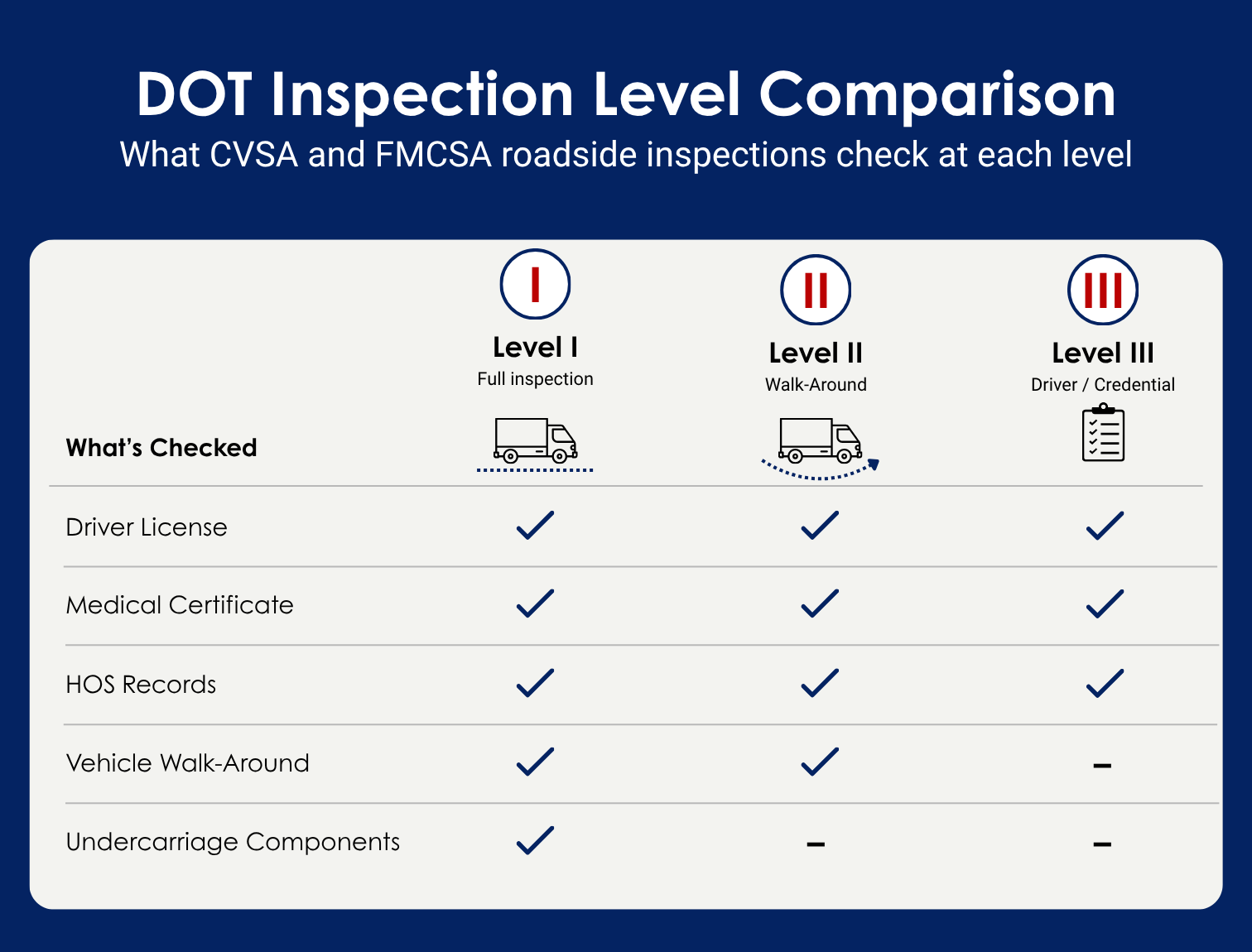
DOT inspection levels are federal inspection categories. The Commercial Vehicle Safety Alliance (CVSA) defines them. They range from a full driver-and-vehicle check to a quick paperwork review. CVSA sets eight levels in total, but new drivers are most likely to encounter three of them.
- Level I (North American Standard Inspection): the most thorough check. It covers the driver’s license, medical certificate, and hours of service records. It also includes a full vehicle inspection, including parts underneath the truck.
- Level II (Walk-Around Inspection): covers the same driver paperwork as a Level I inspection. It skips any parts that require getting under the vehicle.
- Level III (Driver/Credential Inspection): reviews only the driver’s license, medical certificate, and hours of service records. There is no vehicle check.
Levels I, II, and III make up about 96 percent of the roughly 3 million roadside inspections FMCSA conducts each year. Keeping paperwork current and a truck in good condition makes any of these checks straightforward. Drivers get first exposure to these standards during CDL testing, well before their first solo trip.
Why Does Load Securement Matter?
Load securement matters because cargo that shifts during transport creates a serious safety risk. It endangers the driver and everyone else on the road. Federal rules require that cargo be blocked, braced, or tied down so it can’t move, tip, or fall during transport. Common methods include tie-down straps, chains, and blocking made from lumber or metal bars, which keeps a load from sliding forward or backward. Drivers also need the right number of tie-downs, based on the weight and shape of the load.
Securement isn’t a box to check before pulling out of the yard. A shifted load can throw off a truck’s balance, damage cargo, or fall onto the roadway. Learning to secure a load properly is one of the practical skills that separates a well-trained driver from someone who is only technically qualified. It also pays off in a smoother, calmer trip.
How Do Hours of Service Rules Work in Practice?
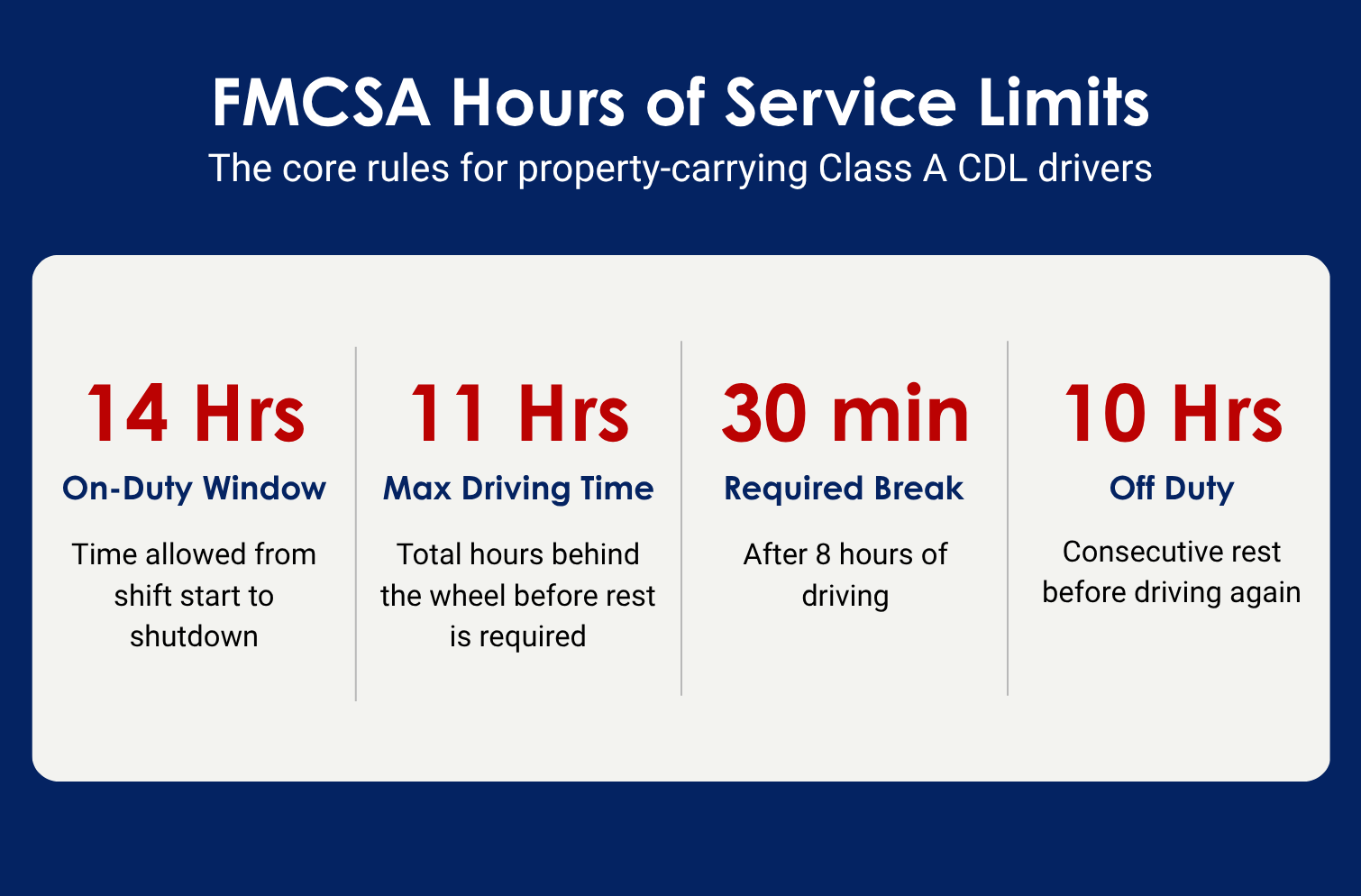
In practice, hours of service (HOS) rules shape a driver’s day. The Federal Motor Carrier Safety Administration (FMCSA) sets these rules. Drivers can drive up to 11 hours within a 14-hour on-duty window, with a 30-minute break required after 8 hours of driving. Once that window closes, a driver needs 10 consecutive hours off duty before starting a new shift. New drivers learn the basics of HOS and logging during Class A CDL training. They also learn to use electronic logging devices (ELDs), which track each driver’s own hours in real time. That real-time countdown covers a driver’s own remaining drive and on-duty time. It does not track the truck’s location.
The rules become second nature once a driver plans their routes around them. Knowing how much driving time is left is part of the daily rhythm of the job, not a separate task to think about later. Every Apex program follows the federal Entry-Level Driver Training (ELDT) mandate, so new drivers get this rhythm built in from day one.
Ready to Start Your CDL Training?
Apex Technical Institute’s Class A CDL Training program covers shift structure, weigh station stops, DOT inspections, load securement, and hours of service from day one. Graduates already know what to expect before their first solo run. Enroll today to start training.
Frequently Asked Questions
Is getting weighed the same as being inspected?
No. A weigh station checks a truck’s weight, while a DOT inspection checks safety and paperwork. A driver can go through one without the other.
What happens if a truck is overweight at a weigh station?
The driver may need to shift the load, offload some cargo, or pay a fine. The outcome depends on the state and how far over the limit the truck is.
Can a driver be placed out of service after an inspection?
Yes. A serious violation can take the driver or truck out of service until it’s fixed. Common examples include an expired medical certificate or a critical vehicle defect.
How often can a driver expect to be inspected?
There’s no fixed schedule. It depends on the driver’s route, the state, and random selection at weigh stations and checkpoints.
Who is responsible for securing a load properly?
The driver is responsible for confirming the load is secured, even if someone else loaded the truck.
Can a driver refuse to run a route if the cargo doesn’t seem secure?
Yes. A driver should fix unsafe securement before driving, since the driver is the one held responsible if cargo shifts on the road.
Do hours of service rules apply the same way to every driver?
The basic driving and rest limits apply to most property-carrying drivers. Some exceptions exist for certain routes and vehicle types.
What happens if a driver runs out of hours before reaching a stop?
The driver has to stop and rest once the allowed drive time runs out, even if it means stopping short of the planned destination. The ELD won’t log more drive time until the required rest is taken.