
Using the GI Bill® for CDL Training
Step by Step Guide for Veterans
The GI Bill covers CDL (Commercial Driver’s License) training for eligible veterans. If you have GI Bill benefits available, attending a VA-approved CDL school can get you licensed without paying out of pocket. How much gets covered depends on your benefit level, which is based on how long you served on active duty.
The truth is: the GI Bill can be used to earn your CDL at VA-approved schools that offer CDL training. This guide covers everything a veteran needs to know: which benefit chapter applies to you, exactly what gets paid and how, how to find a VA-approved CDL school anywhere in the country, how to apply, and more.
Table of Contents
- Does the GI Bill Cover CDL Training?
- Which GI Bill Chapter Applies to You?
- What the GI Bill Pays For at CDL School
- How to Find a VA-Approved CDL School
- Other Ways to Pay for CDL Training
- The Military CDL Skills Test Waiver
- How to Apply: Step by Step
- Frequently Asked Questions
Does the GI Bill Cover CDL Training?
The VA officially lists truck driving school as a covered job training program. They call it a “non-college degree” program, which puts it in the same category as HVAC training, EMT school, and cosmetology programs. (VA.gov)
The school has to be approved by its state’s approving agency before it can accept GI Bill students. Once a school has that approval, the GI Bill works the same way it would for any other approved program. In some cases, a veteran’s spouse or child can also use transferred GI Bill benefits to attend CDL school. The transfer has to be set up while the veteran is still on active duty.
Which GI Bill Chapter Applies to You?
VA education benefits are split into different programs called “chapters.” Which one applies to you depends on when you served and your current status. All of the following chapters cover CDL training at an approved school.
Chapter 33: Post-9/11 GI Bill (Most Common)
This is the most used program today. To qualify, you need at least 90 days of active duty after September 10, 2001, and an honorable discharge. (VA.gov)
Your benefit level is based on how long you served. The longer you served, the higher your percentage. Benefits are not always 100%, so it is important to check your level before you enroll.
| Time Served on Active Duty | Benefit Level |
|---|---|
| 36 months or more | 100% |
| 30 to 35 months | 90% |
| 24 to 29 months | 80% |
| 18 to 23 months | 70% |
| 6 to 17 months | 60% |
| 90 days to 5 months | 40% |
At 100%, the VA pays tuition directly to the school. It also pays you a monthly housing allowance and a books and supplies stipend while you are in training.
Chapter 30: Montgomery GI Bill (Active Duty)
This is for veterans who served before September 11, 2001. To qualify, you had to contribute $100 per month during your first 12 months of service. Unlike the Post-9/11 GI Bill, the Montgomery GI Bill sends monthly payments directly to you instead of paying the school. Rates are updated by the VA each year. (VA.gov)
Chapter 31: Veteran Readiness and Employment (VR&E)
This program is for veterans who have a service-connected disability rating. It covers the full cost of CDL training, including tuition, required books, tools, and a monthly payment while you train. It also provides job placement support after graduation.
One important advantage: if you use VR&E first, it does not reduce your GI Bill entitlement. You can save your GI Bill benefits for later while using VR&E to pay for CDL training now. (VA.gov)
Chapter 1606: Montgomery GI Bill (Selected Reserve)
This is for members of the National Guard and Reserve. It provides monthly payments toward approved training programs, including CDL school. Payment rates are lower than the Post-9/11 GI Bill but the program works the same way for approved vocational programs.
Not sure which chapter you qualify for? Call the VA Education Hotline at 1-888-442-4551 or log into VA.gov to check your Statement of Benefits before you contact any school.
What the GI Bill Pays For at CDL School
Under the Post-9/11 GI Bill at 100% benefit level, three separate payments are made when you enroll in a VA-approved CDL program.
1. Tuition and Required Fees
The VA pays tuition and required program fees directly to the school. The cap for non-college degree programs is $29,920.95 for the 2025-2026 school year, rising to $30,908.34 for 2026-2027. (VA.gov) CDL programs cost well below this cap, so tuition is usually covered in full.
What counts as a “fee” depends on how the school structures its program costs. If items like a DOT physical or background check are bundled into the school’s required program fees, they may be covered. If they are billed separately outside the program, they likely are not. Always ask the school’s VA Certifying Official exactly what is included in the fees they report to the VA.
2. Monthly Housing Allowance
The VA pays you a monthly housing allowance while you are enrolled at least half-time. The amount is based on the Department of Defense pay rate for an E-5 with dependents, using the zip code of your school’s location. Housing allowance varies by location, so the amount you receive depends on where you train.
You do not receive a housing allowance if you are on active duty, if your tuition is fully covered by military tuition assistance, or if you are enrolled at less than half-time. You can look up current rates by zip code at the Defense Travel Management Office website.
3. Books and Supplies Stipend
The VA pays up to $1,000 per year for books and required supplies. This is paid directly to you at the start of each enrollment period.
Your Rights as an Enrolled Student
Under federal law (Title 38 U.S. Code Section 3679(e)), a VA-approved school cannot do any of the following while your VA payment is being processed:
- Delay or deny your enrollment
- Charge you late fees
- Require you to set up an alternative payment plan
- Block your access to classes or school resources
This protection applies to Post-9/11 GI Bill (Ch. 33) and VR&E (Ch. 31) students during the first term of enrollment.
How to Find a VA-Approved CDL School
Not every CDL school is approved to accept GI Bill funding. If you enroll at a school that is not VA-approved, your benefits will not cover it no matter how good the school is. Always verify approval before you sign anything.
The official tool for this is the VA’s WEAMS Institution Search:
Search the WEAMS Institution Database
When you search, do these four things:
- Select “Non-College Degree” as the institution type
- Filter by your state or city
- Confirm that the specific CDL program, not just the school, is listed and approved
- Check that the approval has not expired
You can also use the VA’s GI Bill Comparison Tool to compare approved programs, estimate your housing allowance by location, and review school details side by side.
What if the school near you is not approved? Schools can apply for VA approval through their state approving agency. Veterans have directly asked local schools to pursue approval, and it has worked. A school gains access to more students by getting approved, so there is a real reason for them to do it.
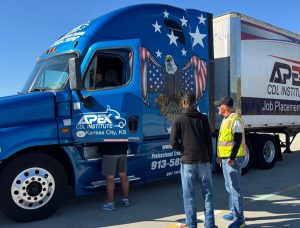
Apex Technical Institute is a VA-approved CDL training provider.
Other Ways to Pay for CDL Training
The GI Bill is not the only option. These programs can work alongside your GI Bill benefits or replace them if your entitlement has run out.
Veteran Readiness and Employment (VR&E, Chapter 31)
If you have a service-connected disability, VR&E covers the full cost of CDL training and does not use your GI Bill entitlement when applied first. Contact your nearest VA Regional Office or visit VA.gov to start the process.
Military Apprenticeship Program (MAP)
Some trucking companies participate in the Department of Defense Military Apprenticeship Program. This lets veterans earn a monthly education benefit check on top of their regular wages from a new trucking job. For qualifying veterans, this can add up to $1,400 extra per month during the apprenticeship period. Ask any employer you are considering whether they participate in MAP.
Workforce Innovation and Opportunity Act (WIOA)
WIOA is a federal grant program, not a loan. It funds training in high-demand jobs including commercial truck driving. Veterans get priority under the Jobs for Veterans Act (PL 107-288), which means they move to the front of the line for any WIOA-funded program. WIOA does not affect your GI Bill entitlement.
The Military CDL Skills Test Waiver
If you drove certain vehicles in the military, you may be able to skip part of your CDL testing. The Federal Motor Carrier Safety Administration (FMCSA) allows states to waive the CDL skills test for veterans who operated a military vehicle that is comparable to the CDL class they are applying for.
Some states go further and waive both the written and driving tests for veterans with qualifying job specialties (MOS or rating).
Vehicles that typically qualify for a waiver: semi-trucks, large cargo trucks, fuel tankers, and other heavy vehicles similar in size and operation to commercial vehicles.
Vehicles that typically do not qualify: tanks, Humvees, light tactical vehicles, and other military equipment that does not match the operation of a commercial truck.
The general conditions that apply in most states are:
- Your discharge or separation happened within the past 12 months (this varies by state)
- The military vehicle you drove was comparable in class to the CDL you are applying for
- You had no traffic violations or accidents in that vehicle during the qualifying period
- You need a certification form signed by a commanding officer
Waiver rules vary by state. Contact your state DMV or Department of Transportation to find out what applies to you. The FMCSA also has a state-by-state summary at fmcsa.dot.gov.
Even with a waiver, most states still require classroom hours. CDL schools can walk you through whatever steps remain for your specific situation.
How to Apply: Step by Step
Step 1: Check Your Remaining Benefits
Log into VA.gov to view your Statement of Benefits. This tells you which chapter you qualify for, your benefit percentage, and how many months you have left. Veterans can get up to 36 months of benefits total, with a combined maximum of 48 months across all VA education programs. If you do not have online access, call 1-888-442-4551.
Step 2: Apply for a Certificate of Eligibility (COE)
Submit VA Form 22-1990 at VA.gov. This is the official document that proves you are eligible for benefits. Processing usually takes about 30 days. Apply before you contact schools so you are ready to move quickly.
Step 3: Find and Contact a VA-Approved CDL School
Use the WEAMS tool or GI Bill Comparison Tool to find approved schools in your area. When you call a school, ask specifically for their VA Certifying Official. That is the person who handles all GI Bill enrollments. Confirm that the CDL program itself is approved, not just the school.
Step 4: Submit Your COE to the School
Give your Certificate of Eligibility to the school’s VA Certifying Official. They submit your enrollment to the VA on your behalf. You do not contact the VA to arrange payment yourself. The VA pays tuition directly to the school and sends your housing allowance directly to you.
Step 5: Verify Your Enrollment Each Month
If you receive a Monthly Housing Allowance under the Post-9/11 GI Bill, you are required to verify your enrollment each month to keep receiving payments. The VA will explain how to do this when your benefits start.
Step 6: Complete Training and Get Licensed
Most full-time CDL programs take four to eight weeks to complete. When you finish, you will be ready to take your state CDL skills test and get your commercial driver’s license. Passing the test depends on your performance and your state’s requirements. A Class A CDL is the most widely accepted commercial license in the country and qualifies you to drive tractor-trailers and most other commercial vehicles.
Frequently Asked Questions
Can I use the GI Bill to pay for CDL school?
Yes. The VA covers CDL programs at approved schools as a “non-college degree” job training program. The Post-9/11 GI Bill pays up to $29,920.95 in tuition for the 2025-2026 school year, plus a monthly housing allowance and a books and supplies stipend. How much you receive depends on your benefit level, which is based on your length of active duty service.
Which GI Bill chapter is best for CDL training?
For most veterans, the Post-9/11 GI Bill (Chapter 33) gives the most value because it pays tuition directly to the school and adds a housing allowance on top. If you have a service-connected disability, look into VR&E (Chapter 31) first. It covers the full cost of training and does not reduce your GI Bill entitlement when used first.
How do I find a VA-approved CDL school near me?
Use the VA’s WEAMS Institution Search tool at benefits.va.gov. Select “Non-College Degree” as the type and search by state or city. Always confirm that the specific CDL program, not just the school, is listed and currently approved before you enroll.
Can I use VR&E for CDL training if I have a disability rating?
Yes. VR&E (Chapter 31) is available to veterans with a service-connected disability and an employment handicap. It covers full tuition, books, required supplies, and a monthly payment while you train. If you use VR&E first, your GI Bill entitlement stays intact for future use.
Does using the GI Bill for CDL training use up my education benefits?
Yes, but not much. A four-week full-time program uses about one month of entitlement. If you have 36 months of Post-9/11 GI Bill benefits, you would still have over 34 months remaining after completing a standard CDL program.
Can I get a CDL test waiver based on my military driving experience?
It depends on what you drove and what state you are in. The FMCSA lets states waive the CDL skills test for veterans who operated a comparable commercial vehicle in the military. Tanks, Humvees, and light tactical vehicles generally do not qualify. Large cargo trucks, fuel tankers, and semi-truck equivalents often do. Contact your state DMV or visit fmcsa.dot.gov for details.
Can my spouse or dependents use GI Bill benefits for CDL training?
Possibly. If a veteran transferred their Post-9/11 GI Bill benefits to a dependent, that dependent can use the benefits at a VA-approved CDL school the same way a veteran would. Transfers must be set up while the veteran is still on active duty. (VA.gov)
GI Bill® is a registered trademark of the U.S. Department of Veterans Affairs (VA). More information about education benefits offered by VA is available at the official U.S. government website at benefits.va.gov/gibill.
Additional Resources
- VA.gov – Non-College Degree Programs
- VA.gov – Current Post-9/11 GI Bill Rates
- VA.gov – GI Bill Comparison Tool
- WEAMS Institution Search (Find Approved Schools)
- VA.gov – Veteran Readiness and Employment (VR&E)
- FMCSA – Military CDL Skills Test Waiver by State
Sources
- U.S. Department of Veterans Affairs – Non-College Degree Programs: va.gov
- VA News – “Easier Access to Commercial Driver’s License Training for Veterans,” May 2026: news.va.gov
- VA.gov – Post-9/11 GI Bill Chapter 33 Current Rates (2025-2026): va.gov
- VA.gov – Post-9/11 GI Bill Chapter 33 Future Rates (2026-2027): va.gov
- VA.gov – Compare VA Education Benefits: va.gov
- Federal Motor Carrier Safety Administration – Military CDL Waivers: fmcsa.dot.gov
- VA.gov – Choosing a GI Bill-Approved School: va.gov